Two-character design guide

Perseverance in Chinese Tattoo: 坚持, 毅力 & Design

坚持 (jiānchí) means to persevere, persist or keep doing something. 毅力 (yìlì) names willpower; 忍 means endure or forbear, and 韧性 means resilience rather than persistence. Compare the full phrase before using it permanently.

Pinyin jiān chíStrokes 16 across 2 charactersMeaning to persevere, persist, stick withTraditional 堅持

Quick answer: Perseverance in Chinese is usually 坚持 (jiānchí), meaning to keep going, or 毅力 (yìlì), meaning willpower. 忍 means endure or forbear, and 韧性 means resilience, so both are related but not direct synonyms; 持之以恒 and 锲而不舍 are stronger literary idioms for a tattoo or motto.

What does 坚持 mean?

坚持 (jiānchí) means to persevere with something, persist, stick with a task or hold to a position. 坚 relates to firmness or strength, and 持 relates to holding. It is a common modern word used for effort, discipline, training, study and commitment. The phrase describes continued action; it does not promise that the effort will produce a particular result.

坚持, 坚强, 持续 and 执着

坚持 means to keep doing something or hold to a course. 坚强 describes a person as strong, resilient or emotionally firm. 持续 means to continue or last, and usually describes an action, condition or trend rather than a personal quality. 执着 can mean persistent, devoted or attached to something, but it can also sound stubborn or obsessive depending on context. These words overlap, yet replacing one with another changes the grammar and tone.

Is 坚持 used in Chinese names?

坚持 is usually a motto, slogan or value phrase rather than a standard personal given name. It can appear in study plans, training material, motivational artwork and brand language. A personal name using the two characters would need a full surname, tone, sound and written-form review because a common word does not automatically become a natural personal name.

Is 坚持 suitable for a tattoo?

Yes, if the intended meaning is persistence or continued effort. The phrase has 16 strokes across two characters and works in a horizontal line or balanced block. 坚 / 堅 has a dense left-right structure, so both components need enough separation. A fine cursive style can close the internal strokes and make the exact phrase harder to verify.

Simplified 坚持 and traditional 堅持

坚持 is simplified; traditional is 堅持. The first character changes form, so do not mix simplified 坚持 with traditional characters elsewhere in the same design. Choose one writing system and keep it consistent.

Design notes

ScriptRegular script keeps the left-right components of 坚 / 堅 distinct and countable.
ScaleAllow enough width for both characters instead of squeezing them into a narrow strip.
ContextUse the phrase for continued effort, not as a promise of success or a command to continue through harm.

What it does not mean

坚持 does not guarantee success, wealth, health or a specific outcome. It also does not mean that someone should continue in an unsafe, abusive or impossible situation. Persistence still needs direction, feedback, rest and a willingness to change course when the evidence changes.

Common mistakes

  • Treating the phrase as a success guarantee.
  • Using 坚持 when 坚强, 持续 or 执着 would fit the sentence better.
  • Mixing simplified 坚持 with traditional 堅持.
  • Using a fine script that hides the structure of the first character.
  • Turning a value phrase into a demand to continue through harm.

Chinese perseverance symbol questions

What does 坚持 mean in Chinese?

坚持 (jiānchí) means to persevere, persist or keep doing something. It can describe continued effort, a firm position or the decision not to give up.

What is the difference between 坚持, 坚强, 持续 and 执着?

坚持 means to persevere or keep doing something. 坚强 describes being strong or resilient, 持续 means to continue or last, and 执着 can mean persistent or attached, sometimes with a stubborn tone.

Does 坚持 guarantee success?

No. It describes continued effort, not a promised result. Persistence still needs direction, feedback, rest and sensible limits, especially when a situation is harmful or impossible.

Is 坚持 written the same in simplified and traditional Chinese?

No. 坚持 is simplified; the traditional form is 堅持. Keep one writing system consistent throughout the design.

Is 坚持 suitable for a tattoo or design?

It can work when the intended meaning is persistence or continued effort. The phrase has 16 strokes across two characters and needs enough room for the dense left-right structure of 坚 or 堅.
Related character guides

Reference data

Character identity and the fields below are taken from the Unicode Unihan database (Unicode 18.0.0), the reference dataset published by the Unicode Consortium. Stroke counts follow the Unihan counting convention.

坚U+575A · 7 strokes (Unihan kTotalStrokes) · radical 土 32 · Mandarin jiān · Cantonese gin1 · “hard, strong, firm; resolute”
持U+6301 · 9 strokes (Unihan kTotalStrokes) · radical 手 64 · Mandarin chí · Cantonese ci4 · “sustain, support; hold, grasp”

Source: Unicode Unihan database, Unicode 18.0.0, generated 2026-09-25.

Word comparison

Perseverance in Chinese: 坚持, 毅力, 持之以恒 and 锲而不舍

Perseverance in Chinese is usually 坚持 (jiān chí), a two-character verb meaning to persist or stick with something. Related words separate willpower, steady effort and the classical idioms. The table shows which one fits a sentence, a motto or a design.

Perseverance in Chinese: 坚持, 毅力 and related words
ChinesePinyinCore senseUse and caution
坚持jiān chíTo persist, to stick withThe everyday verb for persevering; commonly used with 不懈.
毅力yì lìWillpower, perseveranceA noun naming the inner quality rather than the act.
持之以恒chí zhī yǐ héngTo persevere steadilyA four-character idiom; about consistency over time.
锲而不舍qiè ér bù shěTo carve on without giving upClassical idiom from the Xunzi; strong and literary.
坚持不懈jiān chí bù xièTo persevere without slackeningBuilds on 坚持; a common four-character phrase.
努力nǔ lìTo work hard, effortAbout effort, not necessarily long-term persistence.
放弃fàng qìTo give upThe opposite of 坚持; use only when that meaning is intended.

The jiān chí in 坚持 is the ordinary verb for persevering, 毅力 names the willpower behind it, and 持之以恒 and 锲而不舍 are the literary idioms. If the intended meaning is hard work in the moment, use 努力. Perseverance expresses a value and an effort; it is not a promise that the effort will succeed.

Questions about perseverance in Chinese

What is perseverance in Chinese?

Perseverance in Chinese is usually 坚持 (jiān chí), meaning to persist or stick with something. 毅力 (yì lì) names the willpower behind it.

What does 锲而不舍 mean?

锲而不舍 (qiè ér bù shě) means to carve on without giving up — to persevere. It is a classical idiom from the Xunzi.

What is the difference between 坚持, 毅力 and 努力?

坚持 is the verb to persist, 毅力 is the noun for willpower, and 努力 means to work hard or effort — effort in the moment rather than long-term persistence.

Which phrase is best for a perseverance tattoo?

坚持 is compact and clear; 持之以恒 and 锲而不舍 are four-character idioms with a more literary tone. Keep the whole phrase together and confirm the meaning with a fluent reader.

How many strokes does 坚持 have?

坚 has 7 strokes and 持 has 9 in simplified form. The traditional form is 堅持, because 坚 becomes 堅.

What is the difference between 坚持 and 坚强?

坚持 is to persist in an action or position. 坚强 is to be strong and resilient in character.

What does 持之以恒 mean?

It means to persist with constancy — to keep at something steadily over time. It is a common idiom about sustained effort.

What does 执着 mean?

执着 means persistent or devoted. It can be positive, but it can also suggest being stubbornly attached to one goal.

Is 忍 a good Chinese tattoo for perseverance?

忍 (rěn) means endure, bear or hold back. It is not a direct synonym for perseverance, so choose it only when endurance or forbearance is the intended meaning.

Does 韧性 mean perseverance in Chinese?

韧性 (rènxìng) is closer to resilience, toughness or elasticity. Perseverance is more often 坚持 (jiānchí) or 毅力 (yìlì).

What is the best single Chinese character for perseverance?

There is no exact one-character synonym that covers every sense. 毅 is the closest single character for resolve or grit, while 忍 means endure or forbear and 坚 means firm or solid. A two-character phrase such as 坚持 or 毅力 is usually clearer.

Tattoo wording

Which perseverance phrase fits a tattoo?

For a tattoo, the search phrase “perseverance in Chinese” points to several options rather than one universal translation. 坚持 is the clearest compact wording when the meaning is to keep going, while 毅力 names willpower as a quality. 持之以恒 and 锲而不舍 are four-character idioms with a more literary tone.

  • Compact design: 坚持 is the direct option for a small permanent line.
  • Literary motto: 持之以恒 emphasises steady effort over time; 锲而不舍 uses the image of carving without giving up.
  • Willpower as a noun: 毅力 describes resolve or grit rather than the act of persisting.

Keep the phrase in one script, review the complete wording with a fluent reader and test the stencil at the final size. The phrase can express perseverance; it does not promise that a goal will succeed.

Word choice

毅力, 坚持, 忍, 韧性: which Chinese tattoo means perseverance?

English hides several ideas inside one word. Chinese separates the action of persisting, the personal quality of willpower, the act of enduring, and the ability to recover. That distinction matters more in a permanent design than in a casual translation.

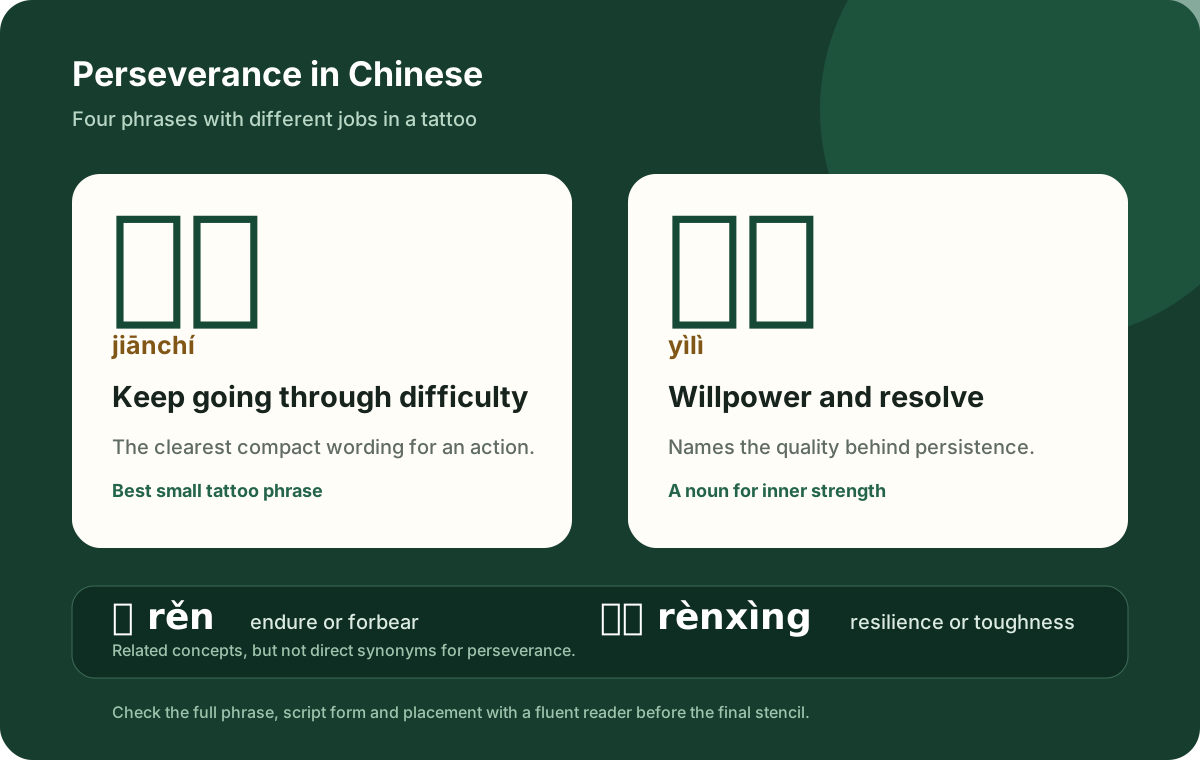
Comparison of 坚持 (jiānchí) and 毅力 (yìlì) for a perseverance tattoo, with related words 忍 and 韧性
坚持 is the clearest choice for continuing an action; 毅力 names willpower as a quality. 忍 and 韧性 are related, but they are not direct synonyms.
Chinese words often translated as perseverance or resilience
ChinesePinyinClosest English senseTattoo use
坚持jiānchíTo persist, keep going or hold to a courseThe clearest compact wording when the meaning is continued action. Traditional: 堅持.
毅力yìlìWillpower, resolve, gritA noun for the quality behind persistence; useful when the design names inner strength rather than an action.
忍rěnTo endure, bear or hold backA single-character option, but it means endurance or forbearance, not perseverance in the sense of continuing a goal.
韧性rènxìngResilience, toughness, elasticityCloser to the ability to bend without breaking. It is not the usual word for “keep going”.
坚韧jiānrènTough and tenaciousUsually describes character or material; compare strength 力 and bamboo 竹 if resilience is the central idea.
持之以恒chí zhī yǐ héngPersevere steadily over timeA four-character idiom with a literary, motto-like tone.
锲而不舍qiè ér bù shěCarve on without giving upA stronger classical idiom, useful when the design needs a complete phrase.

If the design must stay short, 坚持 is the least ambiguous single phrase for perseverance. 毅力 is the better choice for willpower as a quality. Choose 忍 only if endurance, restraint or forbearance is the intended meaning; compare the dedicated 忍 patience guide first. 韧性 can work for resilience, but it is a different concept and should not be presented as a direct translation of perseverance.

Writing and usage

Writing 坚持: 7 + 9 strokes

坚持 is a two-character word: 坚 (jiān) has 7 strokes in simplified form and 持 (chí) has 9. The traditional forms are 堅 and 持, and 坚 becomes 堅, so a traditional design writes 堅持. 坚 carries the sense of firmness or solidity, and 持 means to hold or maintain — together they mean to keep holding on, to persist. Write 坚 first, then 持; both characters are moderately dense, so the pair needs room to stay legible.

坚持 in common words

坚持 forms 坚持不懈 (“persistent, unremitting”) and 坚持下去 (“to keep going”). Its family includes 坚强 (“strong, tough”), 坚守 (“to hold firmly, to stand by”), 坚定 (“firm, resolute”), 持续 (“to continue, sustained”), 执着 (“persistent, attached; sometimes stubborn”) and 毅力 (“willpower”). 持之以恒 (“to persist with constancy”) and 锲而不舍 (“to carve without letting go,” from Xunzi) are common idioms about sustained effort. 水滴石穿 (“dripping water wears through stone”) is the classic image.

坚持, 坚强, 持续, 执着: usage comparison

These words overlap but are not interchangeable. 坚持 is to persist in an action or position. 坚强 is to be strong and resilient in character. 持续 is for something that continues over time, often not a personal choice. 执着 means persistent or devoted, and it can carry a warning of being stubbornly attached. So a person who does not give up is 坚持; a person who does not break under pressure is 坚强; a trend that continues is 持续; and a person fixated on one goal may be 执着, positively or negatively.

Design notes and limits

坚持 is a two-character phrase, so a design carries both characters together or explains which one is used. As a motto it expresses persistence; it does not promise that effort will succeed, and it does not mean that continuing without limits is always wise — the page states the meaning rather than presenting the phrase as a guarantee. Confirm the simplified 坚持 or traditional 堅持 form, check the two characters side by side, and test the drawing at the final size.

Need a human check for perseverance and continued effort?

Send the complete character or phrase you are considering for perseverance and continued effort, the intended placement and whether you need simplified or traditional writing. A reply can explain the reading, usage and context limits before you use it permanently.

Request a character checkSee what a wording check covers